I pack from a list, every time
The Lists
These are the lists I currently use. Each one fits on a single page. I have each one printed, laminated, and taped to the top of its gear box.
- Day Hike - basic day hike kit, scaled slightly for shoulder season
- Multiday Backpacking - overnight setup, dial clothes and food to trip length
- Ski Tour - basic (big) single day backcountry tour, built for being a few ridges out (the bindings I run are in my ATK HY review)
- Surfing - day session, including wetsuit-by-water-temp table
All four use the same five categories: Navigation, Sun, Insulation, Safety, Extra. That way I can pack it all on autopilot and head out with confidence. The multiday list is exactly what I used to pack for the O Trek in Patagonia.
My Process: List, Identify, Box
I like morning activities, but I’m not a morning person. Every time I say “I’ll just pack in the morning” I forget something, unless I’m using this list. It can completely ruin a day to drive 2+ hours to a trailhead and find out you’re missing some critical gear. With the lists I know that if everything is checked off, I’m good to go and won’t have any issues.
When I’m checking off the list, I always point and name the item. No cheating allowed, I have to physically see and name it. I started doing this after I learned it in avalanche training for Beacon, Shovel, Probe, and it ended up being so effective I use it for all my gear now. This guarantees that everything on the list is making it to the trailhead.
I also set up my storage so I have seasonal activity boxes with these lists on top. Sometimes they share boxes (day hike and multiday backpacking), but most everything on a list should be in the box. There are some exceptions like clothes which keep better in a closet, or fuel which should be stored safely, but all the other essentials can fit in a box. At the beginning of each season I repack each box to make sure everything is clean, up to date, working, and ready to go. Then the night before I make sure the extras (clothes, fuel, etc) make it into the box and it’s ready to go the next morning.
The Research
I used to just do point and name, but sometimes I’d forget things or friends would ask what they should bring on the excursions. I had seen some studies on the effectiveness of checklists and decided to implement it after reading about them.
The B-17
In 1935, Boeing’s prototype Model 299 (precursor to the B-17 Flying Fortress) crashed on takeoff at Wright Airfield, killing two. Despite his experience, the test pilot had forgotten to disengage a control lock. A reporter wrote the plane was “too much airplane for one man to fly,” but Boeing’s test pilots disagreed. They wrote a checklist that fit on an index card. The Army then flew those 12 test planes a combined 1.8 million miles without a single accident, and went on to order over 12 thousand B-17s.
The WHO surgical safety checklist
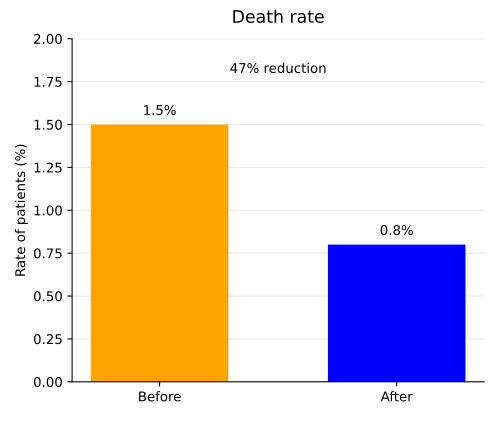
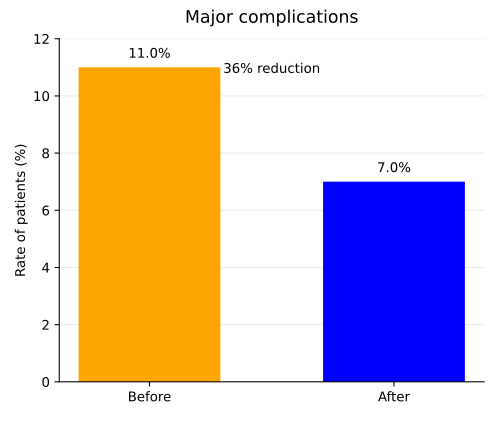
Atul Gawande led a WHO team that designed a 19-item checklist for surgery: sign-in before anesthesia, time-out before incision, sign-out before leaving the OR. They tested it across 8 hospitals in 8 cities, from Seattle to Manila to Dar es Salaam.
The Michigan ICU Project
Peter Pronovost made a 5-step checklist for inserting central lines (a procedure that frequently causes bloodstream infections in ICU patients). The Michigan Keystone Project deployed it across 103 ICUs. Infection rates dropped 66% over 18 months. Roughly 1,500 lives saved and $100M in costs, in one state.
Across all of these examples, we see extremely highly-trained individuals (who already know all the steps) consistently making over 30% fewer mistakes just by the inclusion of a checklist.
Why this works psychologically. Working memory holds about seven items at a time, plus or minus two (Miller, 1956). My ski tour list has more than seven items. My backpacking list has dozens. There is no version of “I’ll just remember it” that scales. Extracting that mental load and putting it on paper has a name in cognitive science: cognitive offloading.
Point and name engages three different brain pathways at once. Pointing focuses your eyes. Saying the name activates the auditory loop. The physical gesture anchors attention. So when I do “beacon, shovel, probe” out loud while pointing at each thing in my box, I’m validating with three unique brain pathways.
Build your own
The PDFs above are tuned to me, my gear, and the climates I ski, hike, and surf in. Yours should be different.
If you want to steal the structure, it’s:
- Navigation - map, compass, phone (charged), permit, itinerary
- Sun - sunscreen, lip balm, eyewear, hat
- Insulation - every layer you’d put on
- Safety - first aid, headlamp, emergency shelter, beacon and friends
- Extra - everything specific to the activity (skis, board, water filter, après in the car)
Items with sub-items work better than two top-level lines. “Phone → charged” beats “Phone” and “Charge phone” because the relationship between them is what matters when you’re tired and rushing. The most common failure mode is grabbing the thing without confirming the state.
Stay safe out there! And feel free to reach out with any questions.
Further Reading
- Surgical Safety Checklist Reduces Mortality and Complications Haynes et al., NEJM 2009
- An Intervention to Decrease Catheter-Related Bloodstream Infections in the ICU Pronovost et al., NEJM 2006
- The Magical Number Seven, Plus or Minus Two Miller, Psychological Review 1956
- Pointing and Calling (Shisa Kanko) Nippon.com
- The Pre-flight Checklist Origin: 1935 B-17 Crash The Aviation Geek Club